Making Reading Sacred
By Frederic and Mary Ann Brussat
http://www.spiritualityandpractice.com/books/features.php?id=10900
As anybody who follows our book reviews on this website has probably guessed, we truly enjoy reading. Reading is one of the ways we practice gratitude, meaning, hospitality, openness, and enthusiasm, and we commend it to you.
You may pick up a new book seeking knowledge on a subject that fascinates you. Or you may feel like exploring an alternative world created by a novelist. When your reading also exercises your faith, fires your imagination, stirs your soul, and expands your circle of compassion, it becomes a sacred activity.
Here are some practices we’ve used to deepen our reading experiences.
• Before you open a book, take a moment to give thanks to God for gifting its creator with the time, energy, creativity, and cooperation needed to make it possible for you to read it now.
• Treat the space where you are reading as a sacred place. Try to eliminate all distractions. Turn off the phone. Close the door. Make a commitment to focus all of your divinely endowed energies of attention and imagination on the text.
• Be a good host to the author. Let go of attitudes that might limit your receptiveness. Forget what you’ve heard about the book so you don’t prejudge it. Don’t expect the author to live up to some standard you’ve established. Instead, just be open to the words, the characters, and the messages as they unfold. Allow yourself to be surprised.
• Don’t rush. Books are meant to be savored like a delicious meal. If you hurry, you may miss some of the important nuances and the subtle textures the author has worked hard to include.
• Be patient with the book. Sometimes you won’t get the author's meaning right away. Maybe, as happens when you are talking with someone, you won’t realize what was meant until you think about it later. If so, go back and reread that section of the book. There’s no rule that you only get one pass through the pages!
• Have a conversation with the author as you read. Underline passages that catch your fancy. Or, if you are reading a borrowed book or a library copy, copy favorite phrases into a notebook. Consider your underlines and notes as the equivalents of standing ovations at a musical performance. Know that a heavily notated book is one that you have taken to heart.
• As you read, notice and relish all the ways that the text speaks directly to you. It may remind you of something you are feeling, some need or yearning. More often than not, God gives us the books we need at just the right time to challenge or comfort us.
• Pause periodically, just hold the book, and allow yourself a moment of reverie. Let your senses come alive after reading a particularly apt description. Harvest the memories a turn of a story brings to mind. See if you identify with what the author or a character is feeling.
• The writings of religious and spiritual teachers, biographies of admirable people, even many novels are good medicine for our souls. They give us the courage to face the truth about ourselves, including any darkness within us, and to endure pain, suffering, and death. Consciously seek out moral mentors in your reading. Let their experiences become a source of inspiration and healing for you.
• Reading a good book is such a joy. Spread that joy around. Send a letter via the publisher to the author or the editor. Write a mini-review and post it where the book is described at one of the online bookstores such as Amazon.com, BarnesandNoble.com, or Borders.com.
• Finally, when you get together with people, talk about what you are reading. Demonstrate your love by passing on a book that is special to you. One of the very best ways to make reading sacred is to use it to create deeper connections with your family, friends, and community.
Tuesday, 15 September 2009

Sunday, 12 April 2009
What is NLP??
Let one of the big names tell you about it...
Robert Dilts with you...
http://www.youtube.com/watch?v=MCEFD4a6524
Warmly
Jamie and Laura
Robert Dilts with you...
http://www.youtube.com/watch?v=MCEFD4a6524
Warmly
Jamie and Laura
Wednesday, 4 February 2009
Educating for the future – according to the experts.
 Alvin Toffler
A very interesting article was published in the supplement of La Nación newspaper of 1 February in which Alvin Toffler, futurologist and expert in social and cultural trends, talked about the world which is coming. The author of Future Shock and the Third Wave, among other books, spoke about the underground tendencies that give direction to mankind and its future on this planet. He explained that we are in the middle of a shift on Earth from societies which evolved as a result of the Industrial Revolution, societies based on the production line, on the mass migration to big urban centres, to the rise of corporations and to the prevalence of bureaucracy. The change is towards a post-industrial model of society, which he calls “The Third Wave” and which he insists will not emerge in a linear or systematic fashion. Moreover, the fact that some present societies are still adjusting from the agrarian societies of the First Wave to the industrial ones means that having then to suddenly incorporate concepts from the new model will make the transition less than easy.
Throughout the article Toffler emphasises the role of education in society and says that countries will have to reform their education systems to prepare students for the changes in work and society that have already arrived and will be occuring with increasing speed. He says that the educational models in the world have been those which gave students the tools to work in factory-like conditions and were based on the assembly line technique. He states that this model is no longer applicable either to the sorts of work and roles humans will fulfil in the future or to the needs and interests of children whose access to the world has been exponentially widened with the advent of the Internet. Schools, he feels, will have to blend what students need to learn in school (such as basic tools for learning) with what they can pick up online. The focus will be on developing skills and abilities which will be at the forefront of demand from future employers. Among these skills are the ability to assimmilate information, adaptability to change and the skill of taking quick decisions.
He envisages schools that stay will open 24 hours a day and have curricula that span across different disciplines and meet both the needs of each student and the businesses or employers who will hire them once they finish their schooling. He says that not only teachers will teach the students but also there will be much more interaction with experts in different fields who will come into school and show the students what they do and how they work in their field.
Has this new system of schooling been introduced anywhere? Toffler says with some evident regret that it has not been adopted by any country. He says many of the developing countries are either too busy integrating into the industrialised world or have not come to grips with the new realities in the world. He also suggests that teachers’ organisations are resistant to many such changes for fear of losing their jobs. Meanwhile, the changes are accelerating and students are finding that more and more of the skills they need are currently to be found outside the educational system.
Toffler interview: http://www.lanacion.com.ar/nota.asp?nota_id=1093953
Or http://yaerahoraenlaradio.blogspot.com/2009/02/el-profeta-del-manana-alvin-toffler.html
Howard Gardner’s latest book is on the “Five Minds of the Future”. In it he decribes the five cognitive skills that will be in greatest demand in coming years.
The first is the disciplined mind which needs to be learnt in school as you master the different academic disciplines. Then there is the synthesising mind which sorts out what is important from the information in a particular area, makes sense of it and can convey it to others. Third is the creative mind which helps us to innovate and make meaningful change.
The two other minds that will need nurturing in school are the respectful mind, which Gardner stresses goes beyond simply tolerating the other to cultivating respect, emotional and interpersonal intelligence to help us live in societies which contain a diversity of perspective and the ethical mind. This fifth mind is a more abstract and reflective mind which allows us to take a step back and assess our behavious in the light of our ethics and responsibilities.
More on Gardner’s latest work can be found at the following sites:
RSA lecture on the subject
http://www.teachers.tv/video/5452
Radio interview on subject http://wamu.org/programs/dr/07/07/19.php
Podcast
http://www.brr.com.au/event/1ACD/60122/27697/wmp/e39dcpuj7c
Howard Gardner (2007). Five minds for the future. Harvard Business School Press: Cambridge, MA.
Sunday, 1 February 2009
February Courses - last places!
RT WEEK 2009
February 09 – 12
A rich selection of workshops to develop teaching and learning skills!
Workshop outlines
| RT WEEK 2009 | Monday 09 February | Tuesday 10 February | Wednesday11 February | Thursday 12 February |
| 9 to 12 | Upping the ante! - more advanced language! A brand new workshop on the latest in native speaker use. | Creating the person you want to be From a basis of the ontology of language, we look at how we can achieve the results we want in our professional and personal life. | The secret to inner drive and stamina How we can enhance the motivation and enthusiasm of our students. | Transforming authentic material Using models and ideas from the media and internet as springboards for language acquisition and practice. |
| | L u n c h | L u n c h | L u n c h | L u n c h |
| 14 to 17 | Neuroscience in action! Ways to maximise learning and the acquisition of language based on the discoveries of neuroscience research | Let’s take a swipe! Yet more advanced language A knowledge of culture can help us to understand subtle differences in the meaning of familiar words and expressions. | Observer or Doer? How to use some simple NLP techniques to start becoming the protagonist of one’s dreams. | Boosting motivation and creativity through drama An array of ideas that will inspire even the laziest and least artistic students. |
Enrolment
Each workshop lasts three hours. AM: 9.00 - 12.00 PM: 14.00 - 17.00.
Venue: Gallardo 719,
Please enrol by phoning (005411) 4641-9068 or by e-mail: rtcourses@resourcefulteaching.com.ar
jamiearg@gmail.com or lauraszmuch@gmail.com
There are limited vacancies per workshop. Enrolment is only guaranteed by payment of fee.
Curso de Programación Neurolingüística
A cargo de: Resourceful Teaching
Directores: Laura Szmuch - Jamie Duncan
El curso intensivo comprenderá los módulos
Módulos y temas a cubrir:
- Conociéndonos más y mejorando nuestra comunicación
- Canales sensoriales
- Lenguaje preciso
- Anclajes
- Descubriendo los recursos internos
- Concientizándonos de los mundos internos de nuestros alumnos y respondiendo a sus programas mentales.
Docentes a cargo del curso:
Laura Szmuch- Lilly Spillman- Jamie Duncan
¿Qué es la PNL ?
Los resultados de la aplicación de
¡disfrutar el proceso!
(adaptado del libro:Aprendiendo inglés y disfrutando el proceso de Laura Szmuch, Ed. Dunken)
Para más información: lauraszmuch@gmail.com
En febrero… ¡el curso que estabas buscando!
Curso de presentaciones eficaces
16-19 de febrero
En este intensivo de cuatro días para educadores, coaches, counsellors y todo aquel que habla en público, cubriremos tanto teoría como práctica para maximizar tu potencial como presentador efectivo.
Preparación de tu presentación - diferentes estilos y posibilidades.
Nutriendo la voz
Cómo redactor propuestas para congresos y otros eventos
Comunicándonos con diferentes tipos de audiencias
Conociendo y preparándote para un determinado tipo de público
Manejo de la tecnología
Cómo manejar situaciones inesperadas y situaciones temidas
Cómo optimizar tus estados internos
Movimientos y gestos
Uso del espacio
Uso del humor
Compartiendo el scenario
Entre otros…
Presentaciones eficaces
Temario
Objetivos de las presentaciones
Tipos de presentaciones (definición y distinciones)
El presentador efectivo y no efectivo
Aspectos de una buena presentación
Adquisición de recursos
Cómo escribir una biodata
Trabajo sobre la voz y la respiración
Llamados a ponencias
Propuestas para congresos
Material impreso para participantes
Preparación de la presentación: objetivos, selección de material, manejo de tiempos, pasos
Canales sensoriales, hemisferios derecho e izquierdo
Material durante la presentación: cuadernillos, powerpoint, etc
Presentaciones individuales o conjuntas
Diferentes tipos de audiencias
Trabajo interno sobre inseguridades en el escenario
Manejo del espacio, movimientos, gestos, contacto visual, lenguaje verbal y no verbal
Manejo de la tecnología
El uso del humor
Manejo de estados internos
El curso dura cuatro días. Tiene muchísima práctica, y, sobre todo, trabajo sobre uno mismo, percepciones, creencias, postura corporal, uso apropiado de la voz.
Ideal para docentes, coaches, counsellors, presentadores en congresos, talleristas, estudiantes, y todo aquel que en algún momento tiene que hablar delante de un público.
Fechas: 16-19 Febrero 9.00 – 17.00
Para más informes o para registrar:
Tuesday, 9 December 2008
Tuesday, 11 November 2008
Last session of Keeping your English Alive
Friday 14 November – Creative Writing for you
Writing creatively is an excellent way to expand and develop our language and a means of expressing ourselves. In this session we will practice a variety of great ideas you can use for your own pleasure or in class.
To confirm your attendance
send me an e-mail lauraszmuch@gmail.com
Writing creatively is an excellent way to expand and develop our language and a means of expressing ourselves. In this session we will practice a variety of great ideas you can use for your own pleasure or in class.
To confirm your attendance
send me an e-mail lauraszmuch@gmail.com
Monday, 13 October 2008
The rights of the reader
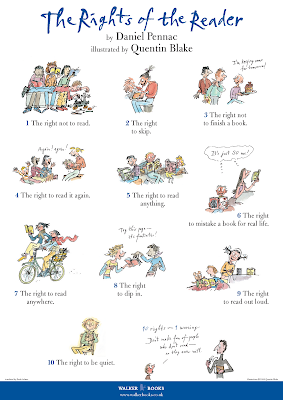
This poster, based on a manifesto by French writer and teacher Daniel Pennac, has been a very popular talking point among educators and librarians around the world.
Josh Lacey in his review for the Guardian Books Review explains how Pennac describes the process of wanting to read and the reasons that we read or don’t choose to read. The main point Pennac makes is that people read because they want to and because it gives them pleasure. There are ways, he suggests, of coaxing people into reading as he has done with reluctant adolescent students. Among the techniques he uses is to read aloud to them to seduce them into the story and also to choose books that are not on the syllabus.
If you think there is something familiar about the poster, Quentin Blake illustrated the Roald Dahl books.
Reviews: http://www.guardian.co.uk/books/2006/oct/28/featuresreviews.guardianreview28
http://www.bostonbibliophile.com/2008/09/review-rights-of-reader-by-daniel.html
Subscribe to:
Posts (Atom)