Friday 14 November – Creative Writing for you
Writing creatively is an excellent way to expand and develop our language and a means of expressing ourselves. In this session we will practice a variety of great ideas you can use for your own pleasure or in class.
To confirm your attendance
send me an e-mail lauraszmuch@gmail.com
Tuesday, 11 November 2008

Monday, 13 October 2008
The rights of the reader
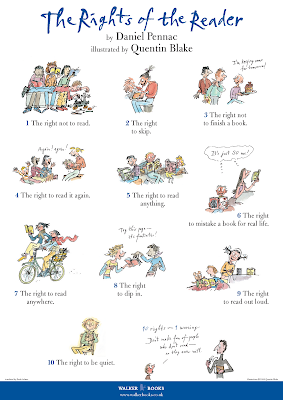
This poster, based on a manifesto by French writer and teacher Daniel Pennac, has been a very popular talking point among educators and librarians around the world.
Josh Lacey in his review for the Guardian Books Review explains how Pennac describes the process of wanting to read and the reasons that we read or don’t choose to read. The main point Pennac makes is that people read because they want to and because it gives them pleasure. There are ways, he suggests, of coaxing people into reading as he has done with reluctant adolescent students. Among the techniques he uses is to read aloud to them to seduce them into the story and also to choose books that are not on the syllabus.
If you think there is something familiar about the poster, Quentin Blake illustrated the Roald Dahl books.
Reviews: http://www.guardian.co.uk/books/2006/oct/28/featuresreviews.guardianreview28
http://www.bostonbibliophile.com/2008/09/review-rights-of-reader-by-daniel.html
Tuesday, 30 September 2008
Keeping your English Alive for teachers!

5th session!!
6 sessions of language discovery and practice held in small groups and designed to give you lots of opportunities to use and develop your English in a fun way.
Fridays 18.30 – 20.30
Versailles, Capital Federal
Friday 10 October – Absolutely, positively postmodern!
What are the clichés and set phrases that native speakers are using these days? Do we know what they actually mean? How do they help conversation flow?
For more information or enrolment please contact lauraszmuch@gmail.com
6 sessions of language discovery and practice held in small groups and designed to give you lots of opportunities to use and develop your English in a fun way.
Fridays 18.30 – 20.30
Versailles, Capital Federal
Friday 10 October – Absolutely, positively postmodern!
What are the clichés and set phrases that native speakers are using these days? Do we know what they actually mean? How do they help conversation flow?
For more information or enrolment please contact lauraszmuch@gmail.com
Thursday, 18 September 2008
Teacher`s Day and what it means to be a teacher
In Argentina it is customary to set aside days to remember and celebrate certain people or professions. We have the universally recognised Mother's Day and Father's Day and there are days for secretaries, newspaper vendors, architects, journalists, students and the different levels of teachers and lecturers. Apart from giving us an excuse to bring a cake to class or to receive presents, and also the possibility of having a holiday, teachers often email each other to wish their colleagues a happy day - all of which is a great display of solidarity. But in a year in which the profile of teachers has been more present than ever in the media due to acts of aggression against them in Argentine schools and strikes for higher wages and better conditions, do we really stop to reflect on what being a teacher means and implies?
Even if the practical steps to help teachers in their work are not always forthcoming, there is little doubt that in the world, teaching is still regarded as a respected profession and there is a recognition of how important a role teachers play in society. We know that this may not translate readily into the sort of support and remuneration that many teachers would like, but the acknowledgement of the job teachers do, at least exists.
While we may not be able to immediately shape the thinking of others as to our role in today’s society, we can clarify our own perception of our work. How many of us as teachers are fully clear as to our importance? Apart from teaching the subject we do, do we remember that we are also teaching by our sheer presence in the classroom, through our behaviour, the model of a person we display in what we say, think and do in front of our ‘audience’?
Teaching is a very public profession. We have many eyes on us constantly. It is a profession which demands responsibility and commitment. We teachers are a significant part of our students’ lives simply by being present and are very often instrumental in their future development.
Therefore, to do our job effectively, it is not only important to know our subject area, to be able to communicate well and to be able to create the conditions for learning in our students, but also to be human beings who act with thoughtfulness, discernment and from the basis of positive moral values.
Then, we can feel that we are working to be the best teacher that we can and celebrate that fact. Then, we have the criteria to show the rest of society that who we are and what we are doing deserves a high degree of recognition. Then we know that we are living up to the faith and trust placed in us.
When we do our job in this way, which any professional should do, we get the rewards and gratitude that we have no doubt been receiving in the last few days. We also provide the foundation upon which the merit of our work can be evaluated and, if necessary, revalued.
Even if the practical steps to help teachers in their work are not always forthcoming, there is little doubt that in the world, teaching is still regarded as a respected profession and there is a recognition of how important a role teachers play in society. We know that this may not translate readily into the sort of support and remuneration that many teachers would like, but the acknowledgement of the job teachers do, at least exists.
While we may not be able to immediately shape the thinking of others as to our role in today’s society, we can clarify our own perception of our work. How many of us as teachers are fully clear as to our importance? Apart from teaching the subject we do, do we remember that we are also teaching by our sheer presence in the classroom, through our behaviour, the model of a person we display in what we say, think and do in front of our ‘audience’?
Teaching is a very public profession. We have many eyes on us constantly. It is a profession which demands responsibility and commitment. We teachers are a significant part of our students’ lives simply by being present and are very often instrumental in their future development.
Therefore, to do our job effectively, it is not only important to know our subject area, to be able to communicate well and to be able to create the conditions for learning in our students, but also to be human beings who act with thoughtfulness, discernment and from the basis of positive moral values.
Then, we can feel that we are working to be the best teacher that we can and celebrate that fact. Then, we have the criteria to show the rest of society that who we are and what we are doing deserves a high degree of recognition. Then we know that we are living up to the faith and trust placed in us.
When we do our job in this way, which any professional should do, we get the rewards and gratitude that we have no doubt been receiving in the last few days. We also provide the foundation upon which the merit of our work can be evaluated and, if necessary, revalued.
Tuesday, 16 September 2008


Thursday, 11 September 2008
Books on NLP- part 1
Books on NLP – part one
In one of our plenaries at the Conference, we listed a number of books written on the application of NLP to educational contexts or books which have had an influence on the classroom. Unfortunately for us in
Some books are available from the author directly (Michael Grinder http://www.michaelgrinder.com/ , Jane Revell http://www.janerevell.com/jane/books.shtml ) and may be more difficult to obtain elsewhere. In this case, dealing with them directly is the best option.
And what about translations? So far, mainly books about NLP generally or their use in business contexts have been translated into Spanish and those bookstores that specialise in self-help books are likely to have a good selection or be able to get hold of them.
Now, an increasing number of texts are being written by Spanish speakers as well and are highly recommendable. As yet, not so many tackle education directly but this will surely change over the next few years.
In this series, we will mention some of the more important NLP books….
One author that is readily translated into Spanish and may also be available in some places in English is Joseph O'Connor.
He and John Seymour wrote Introducing NLP, (available in translation) which gives a good overview of the topic. His more recent books An Introduction to NLP with Ian McDermott and NLP Workbook also give a good basis to NLP. Among other books by this prolific author are Training with NLP, Leading with NLP and The Art of Systems Thinking.
Jazmin Sambrano is a Venezuelan author who has books based on NLP like Superaprendizaje and PNL para todos and El placer de Aprender a Aprender. Her books are available in
Subscribe to:
Posts (Atom)